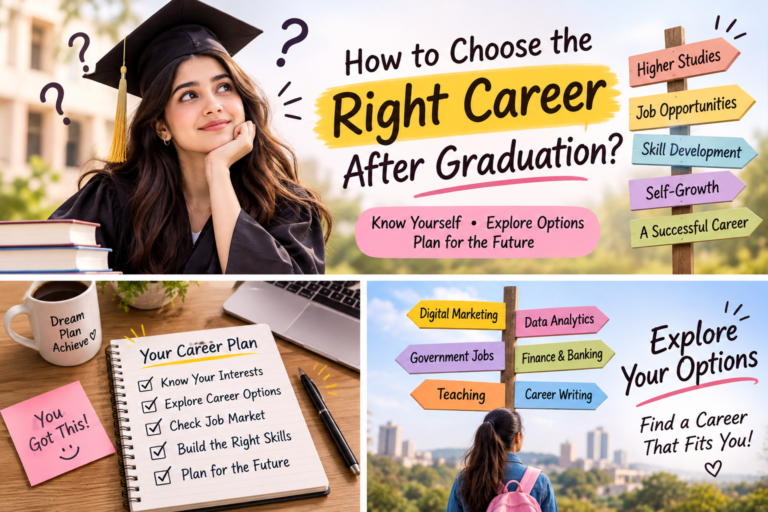


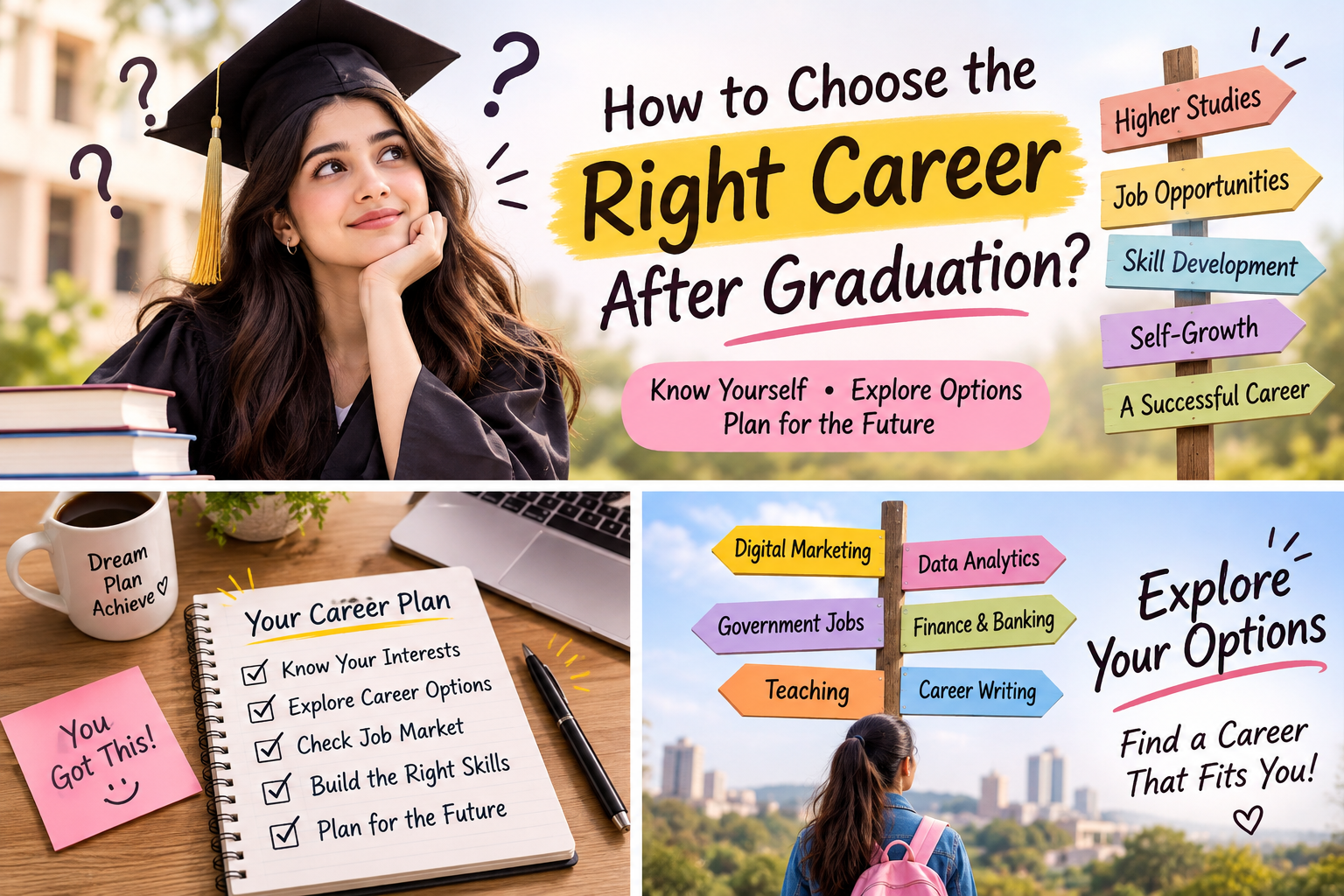
Choosing the right career after schooling is one of the most essential decisions in a student’s life. With hundreds of career options available today, students frequently feel confused about which course, profession, or skill is suitable for them.
Earlier, people mainly chose traditional careers such as engineering, medicine, teaching, banking, and government jobs. Today, things have changed. Technology, online businesses, data analysis, design, and other skill-based fields have opened up many new career opportunities.
In the further section, we will mention the ways that help you to choose the right career after graduation. Keep reading to dive into the depth of the topic.
Value of Choosing the Right Career
A career is not only about getting the offer letter for your first job. It is a long-term journey that might impact your personal growth, income, and job satisfaction.
A suitable career might help you:
- Find better employment opportunities
- Grow professionally over time.
- Enhance your earning possibility
- Work in an industry that matches your interests
- Develop a stable and future-ready career
- Develop skills that are essential in the job field
On the other hand, if you choose a course without understanding your interests, in career goals may be the reason for frustration and wasted time.
Ways to Choose the Right Career After Graduation
Here are the ways to choose the right career after graduation.
Understand Your Rights and Interests
This is the major step that helps you choose the right career after completing graduation. If you are about to look at job opportunities, ensure to think about the things you enjoy doing and the subjects you find interesting.
For instance, if you enjoy writing, communication, and research, you may look at careers in journalism, content writing, digital marketing, or public relations. Similarly, if you love doing work with numbers and solving issues, careers in finance, data analysis, accounting, or business analytics might be suitable for you.
You may ask yourself a few simple questions, such as:
- Which subjects did I enjoy during graduation?
- What activities do I perform well in a natural way?
- Do I enjoy working with individuals, technology, numbers, or innovative ideas?
- Do I prefer working solo or in a team?
- What form of work would keep me interested?
Your answers may assist you in identifying career alternatives that suit your abilities and personality.
Explore Multiple Career Options After Graduation
There are many students who think that they must work in the relevant field after graduation. However, this is not always true. Your degree provides you with academic knowledge, but it doesn’t have to limit your career choices. You may explore numerous fields by learning new skills and gaining practical experience.
Here are well-known career options after graduation.
Digital Marketing- This career option is helpful and suitable for those who are interested in online advertising, social media, content, and business promotion.
Career Writing- If you have writing skills, this field would be ideal for you. It is suitable for those who enjoy writing and explaining ideas; you may choose content writing, copywriting, blogging, and business promotion.
HR (Human Resources)- This career includes hiring employees, handling workplace relationships, and supporting company operations.
Finance and Banking- This option is suitable for graduates who are interested in the field of accounting, money management, and financial services. These sectors may include banking, financial analysis, and related jobs.
Data Analytics- Students who are interested in research, numbers, and problem-solving may explore this field after learning tools such as SQL, Excel, and Power BI.
Teaching and Education- Graduates who like helping others learn may explore tutoring, teaching, educational content creation, and academic support roles.
Government Jobs- Students who prefer public sector employment may prepare for exams conducted by SSC, UPSC, banking organisations, and state-level recruitment bodies.
You may explore these options before deciding. You should not choose a career simply because it is highly popular among your friends.
Research Job Market Demand
A career should match your interests, but you must understand whether opportunities are available in that field. If you are about to choose a career, research the recent job market. Look at the sectors that are increasing, the skills employers require, and the types of roles companies are providing.
For instance, technology-related sectors including artificial intelligence, cybersecurity, data analytics, and software development are receiving enhanced attention.
According to the World Economic Forum’s Future of Jobs Report 2025, AI and big data, technological literacy, and cybersecurity are among the fastest-growing skills expected between 2025 and 2030. Flexibility, innovative thinking, and analytical thinking are also essential.
This doesn’t mean everyone should select a technology career. Rather, it shows why understanding changing job requirements is essential. You may research job opportunities via platforms including Naukri, LinkedIn, and the NCS (National Career Service) portal.
Check job descriptions to understand the experience, qualifications, and skills that are needed for your preferred role.
Identify the Skills You Require to Develop
Having a graduation degree is essential, but employers also seek practical skills. Sometimes, two candidates with similar educational qualifications might have numerous job opportunities because of their skill levels.
Therefore, you should identify the skills needed for your selected career and start developing them.
A few helpful skills include:
- Communication skills
- Computer skills
- Problem-solving
- Technical skills
- Time management
- Teamwork
You may develop these skills via practical projects, online courses, and workshops. Websites such as Coursera, SWAYAM, and other learning platforms offer courses in multiple subjects. You should select courses that are relevant to your career instead of collecting certificates without practical learning.
Consider Higher Education and Professional Courses
Getting a job immediately after graduation is not the only option. Further education might assist you in gaining specialised knowledge and qualifying for specific career opportunities.
For instance:
- B.Com graduates may consider an M.Com, MBA, or professional courses in accounting and finance.
- BA graduates may explore law, MA programmes, journalism, or professional courses.
- B.Sc graduates may consider postgraduate studies, research, or specialised technical courses.
- BBA graduates might explore an MBA or professional courses in business management.
- Engineering graduates may consider postgraduate studies or certifications in specialised technical sectors.
If you are about to enrol in a course, you must check its eligibility needs, course content, fees, career opportunities, and placement support.
Do not choose a degree or diploma only because your close ones are pursuing it. You must ensure it supports your long-term career goals.
Seek Guidance From Experienced People
Sometimes, it might be difficult for you to make a career decision on your own. In such situations, talking to experienced individuals may help. You may consult career counsellors, college professors, or experts working in your desired sector.
You must ask them about their work, needed qualifications, regular responsibilities, and career growth. You may also use career guidance services to understand your interests and suitable career options.
In India, the NCS portal provides career-related information, job opportunities, career counselling, and other employment-related services. You must know that advice should help you make an informed decision. Do not follow someone’s career path blindly because it worked well for them.
Do Not Make Career Decisions Under Pressure
After completing graduation, students often face pressure from friends, family, and society. Few are told to prepare for government exams, while others are encouraged to pursue an MBA or take any available job. You must listen to the advice of others, but your career decision should also reflect your own abilities and interests.
Do not select a field only because it provides a high salary or because everyone around you is choosing it. Similarly, do not feel that you have failed if your first career choice doesn’t work out. You may learn new skills, change industries, or explore multiple roles.
Your first job doesn’t have to be your final career. It might be the starting point of your professional journey.
Gain Practical Experience Via Internships
If you are newly graduated, a lack of work experience can be one of the major challenges for you. Understanding a subject well still requires practical knowledge to work in a professional environment. Internships may help solve this issue.
An internship enables you to work with a company, understand workplace responsibilities, and learn how professionals perform regular tasks. For instance, a student who is interested in digital marketing may intern with a marketing agency. Someone interested in finance may look for an internship with an accounting firm.
Even short internships might help you:
- Understand how an industry works
- Improve your practical skills
- Develop professional connections
- Strengthen your resume
- Discover whether a particular job is suitable for you.
You may look for internships via Internshala, LinkedIn, company sites, and college placement cells.
Final Thoughts
If you have just completed your graduation, you must choose the right career. Choosing a career doesn’t need to be a stressful experience. The suitable career choice is one that matches your strengths, interests, skills, and future goals while providing realistic opportunities for growth.
You may take time to explore numerous fields, research job opportunities, gain practical experience, and seek help when required.
FAQs (Frequently Asked Questions)
Which career is best after completing graduation?
We don’t recommend any single or specific career after graduation. Finance, digital marketing, data analytics, human resources, content writing, teaching, aviation, and government jobs are a few options. The suitable choice depends on your qualifications, interests, and skills.
Can I change my career field after graduation?
Yes, you may change careers after graduation and enter multiple fields by learning the needed skills, completing reliable courses, and gaining practical experience via projects or internships.
Is a degree enough to get a good job?
A degree is a vital qualification, but many employers also look for practical knowledge, communication skills, technical abilities, and work experience.
About the Author